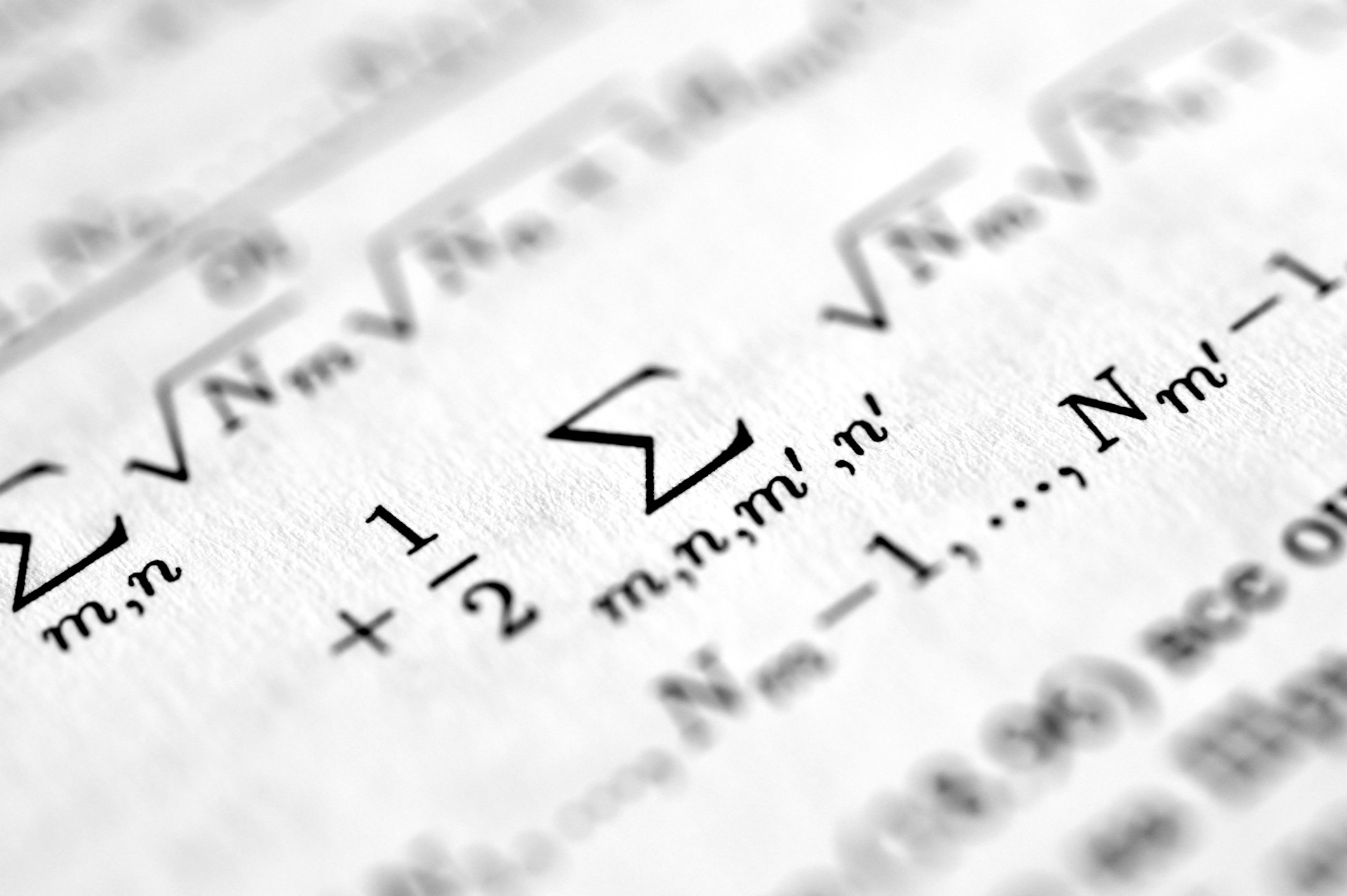
What is a summation, often called “sigma” (∑)? In this article, we start with the basics: what the symbol means, how its parts fit together, and which formulas are useful to know. Let’s take a look!
In mathematics, the symbol ∑, called sigma, provides a shorter way to write the sum of a sequence of numbers.
For example, adding the numbers from 1 to 5 gives:
1+2+3+4+5=15 We can express this using the ∑ symbol together with 1 and 5:
i=1∑5(i)=15 The parts of sigma notation
Sigma notation has three main parts:
i=m∑n(xi) - The lower limit (i=m) tells us where to start. It is written as “variable = starting value.” The variable indicates where each successive value is substituted in the expression being summed. The letter i is common, but any letter can be used.
- The upper limit (n) tells us where to stop.
- The summand (xi) is the expression in that variable that tells us what to add each time. If the variable is i, we can write the expression as f(i).
More examples and how to evaluate them
i=1∑3(2i)n=3∑5(3n)i=∑j=13(j)∑9(i+2)=2(1)+2(2)+2(3)=2+4+6=12=33+34+35=312=4=i=1+2+3∑9(i+2)=i=6∑9(i+2)=(6+2)+(7+2)+(8+2)+(9+2)=8+9+10+11=38 Properties of summation
Let m and n be positive integers with m<n, and let c be any real number.
i=m∑n(xi+yi)i=m∑n(xi−yi)i=m∑n(xic)=i=m∑n(xi)+i=m∑n(yi)=i=m∑n(xi)−i=m∑n(yi)=c⋅i=m∑n(xi) Useful formulas
1. Adding the integers from 1 to n
To add the positive integers from 1 to n, use:
i=1∑n(i)=2n(n+1) For example:
i=1∑3(i)=1+2+3=23(3+1)=6 i=1∑10(i)=1+2+…+9+10=210(10+1)=55 2. Adding a constant
Adding the same number or constant n times is equivalent to multiplication.
i=1∑n(c)=nc For example:
i=1∑5(4)=4+4+4+4+4=5×4=20 i=1∑3(−1)=(−1)+(−1)+(−1)=3×(−1)=−3 3. The difference plus one
We can also use summation to work with a difference. Although the result is not exactly the difference between the bounds, this technique is another way to construct numbers in mental arithmetic.
i=m∑n(ii)=n−m+1; m<n For example:
i=3∑6(ii)=6−3+1=4 i=5+6∑4!+3(ii)=27−11+1=17 Sigma notation may look difficult at first, but once you understand it, you can see how useful it is. We hope you now have a clearer understanding of the symbol and can use it in your studies, understand equations in textbooks, and build hundreds of different numbers in mental arithmetic games.
For more articles like this, follow us on Facebook!